A bedroom can feel calm at night and still work for reading, dressing, and early mornings. The difference often comes from layered light, not one bright ceiling fixture. In 2026, useful ambient bedroom lighting combines soft general illumination with adjustable bedside lamps, indirect light, and controls that suit changing routines. Small changes matter.
The U.S. Department of Energy’s Energy Saver guidance reports that LED bulbs use at least 75% less energy than incandescent bulbs and can last up to 25 times longer. That makes efficient, dimmable LEDs a practical starting point, though bulb choice alone cannot create a comfortable room. The International Commission on Illumination notes that light affects both vision and non-visual responses, with timing and exposure playing a role. In practice, a bright, cool ceiling light may feel useful while making a quiet evening less inviting. Warm, lower-level light can create a gentler atmosphere, but preferences and room finishes differ. There is no magic color temperature for every sleeper.
These Tips For Ambient Bedroom Lighting will explore how to balance brightness, color, placement, and control without turning a bedroom into a showroom. Expect concrete guidance on avoiding glare, lighting dark corners, and choosing fixtures for real tasks. And honestly, a beautifully styled room can still feel flat when the light is wrong. The best setup is the one you can adjust, use comfortably, and live with every day.
Assess Daylight Using CIE’s 250-lx Melanopic EDI Benchmark
In 2026, assess bedroom daylight at the eye, not only on the floor or bedside table. CIE S 026/E:2018 provides a framework for measuring melanopic equivalent daylight illuminance, or melanopic EDI. A 2022 expert consensus in PLOS Biology recommends
at least 250 lx melanopic EDI during daytime, when people are awake.
Treat this as a daytime reference, not a required bedroom setting or a promise of better sleep. Melanopic EDI is not the same as ordinary lux: two rooms with similar lux readings can deliver different light to the eye.
Try this practical check.
Sit on the bed near midday and measure vertically at eye level, facing the window; keep the meter out of direct sun. A small handheld spectrometer is more useful than a basic lux meter for estimating melanopic EDI. If daylight falls short, open the curtains and move a chair closer to the window.
Pale walls can help spread light, but they cannot replace a clear view of the sky. Cloud cover, window direction, and seasonal changes matter. I would recheck on a dull morning, too. One reading is not the whole story.
For evening, reduce bright, eye-level light rather than chasing the daytime benchmark; the same consensus recommends keeping evening exposure below 10 lx melanopic EDI.
Layer Ambient and Task Lighting Around Bedroom Zones
Treat the bedroom as several small lighting zones, not one room needing one bright ceiling fixture.
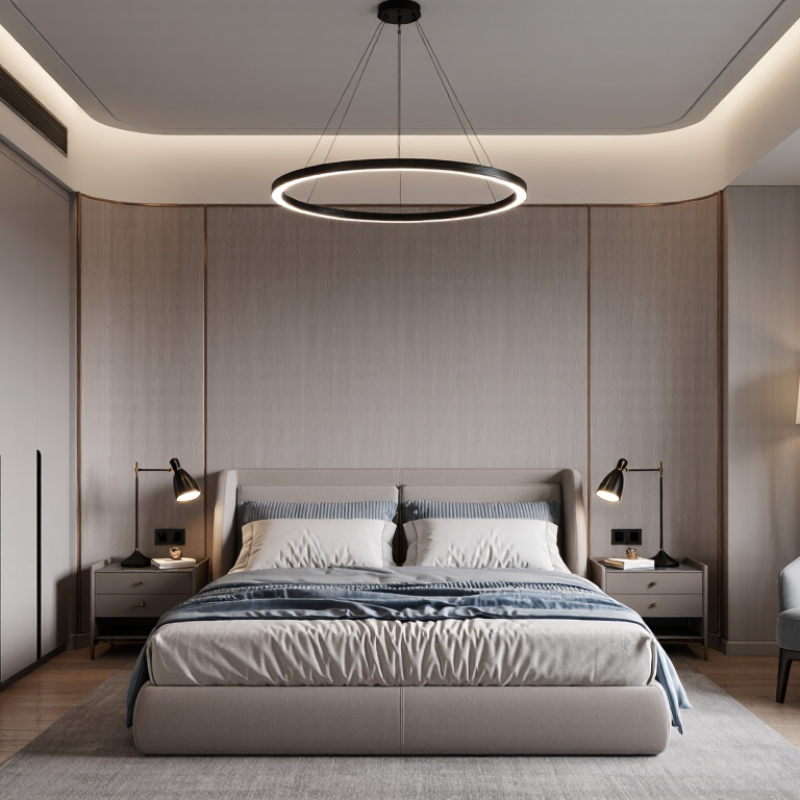
Use a shaded ceiling light or concealed cove lighting for soft general illumination. Then add a focused bedside lamp for reading, positioned so its beam reaches the page rather than your partner’s eyes. A low, warm light near a wardrobe or dresser helps with clothing choices without flooding the whole room. Keep it gentle. Dimmers make transitions easier, though a dimmer cannot fix a poorly aimed bulb.
Choose warm-white, dimmable LEDs for most bedroom layers, and check that bulbs and controls are compatible.
The U.S. Department of Energy’s Energy Saver guidance reports that LEDs use at least 75 percent less energy and last up to 25 times longer than incandescent lighting.
That supports using separate fixtures more freely, rather than relying on one powerful lamp. Try the arrangement at night: sit in bed, read, and notice glare on glossy surfaces or shadows in the wardrobe. One corner may still feel oddly dark. Adjust the lamp angle or add a small local light; bedroom lighting often needs a second look after living with it.
Set Pre-Sleep Lighting Below CIE’s 10-lx Melanopic EDI Guidance
For 2026, make the bedroom’s pre-sleep light gentle and measurable. The key target is below 10 lx melanopic EDI at the eye during the hours before bed, not simply below 10 lux on a room meter. CIE S 026/E:2018 defines melanopic EDI as a way to compare light’s effect on the eye’s melanopsin system. Brown and colleagues’ 2022 expert recommendations in PLOS Biology also set an evening target below 10 lx melanopic EDI. Light level and spectrum both matter.
Try a shaded lamp near the floor, aimed at a wall rather than your pillow. Keep bright ceiling lights off, and avoid a bare bulb shining toward your face while reading. A warm-looking lamp can still deliver substantial melanopic light, so color alone is not proof. Most household lux meters do not report melanopic EDI; precise checking needs suitable spectral measurement. In everyday use, reduce brightness and keep light out of your direct line of sight. A hallway glow can undo careful bedside choices. It is easy to overlook. I still find that one small indicator light catches my eye in a dark room, so cover or reposition unnecessary points of light.
What Are the Best Ambient Bedroom Lighting Tips for 2026? — Set Pre-Sleep Lighting Below CIE’s 10-lx Melanopic EDI Guidance
| When or Where |
Practical Lighting Target |
Ambient Lighting Tips |
How to Check It |
| About 3 hours before bedtime |
Keep light exposure at the eye below 10 lx melanopic EDI where practicable. |
Dim room lighting, use a low-output lamp, and avoid bright light sources in the direct line of sight. |
Melanopic EDI is measured vertically at the eye. A standard lux reading or a bulb’s color temperature alone cannot confirm this target. |
| Bedside reading |
Use the lowest comfortable light level; avoid directing the beam toward the face. |
Choose a shielded, adjustable reading light aimed at the page. Switch it off when reading is finished. |
Check the light from the seated or lying position, not only at the lamp or tabletop. |
| Ceiling and general room lighting |
Reduce brightness during the pre-sleep period rather than relying on a particular color label. |
Use dimmers or separate lighting zones. Turn off unnecessary ceiling lights and avoid bright, exposed sources. |
Assess the light reaching the eyes from normal bedroom positions; room-surface lux is not the same as melanopic EDI. |
| Light color |
Prefer a warmer appearance for evening comfort, while still keeping overall light exposure low. |
Warm-looking light can support a calmer evening atmosphere, but a warm color temperature does not guarantee low melanopic EDI. |
Use a suitable spectral measurement or a validated melanopic EDI calculator with the light’s spectral data if verifying the metric. |
| Night-time navigation |
Provide only enough light to move around safely. |
Use a low-level, shielded pathway light positioned to reduce glare and direct exposure while in bed. |
Check whether the source is visible from the pillow and reduce its output or reposition it if it feels bright. |
| Lighting controls |
Make gradual dimming easy and repeatable each evening. |
Set a consistent pre-sleep routine with dimmers, separate switches, or timed controls. Keep essential safety lighting available. |
Confirm that controls dim the actual light output; some lamps may not dim smoothly or may change color as they dim. |
Measurement note: CIE’s melanopic EDI is a light-exposure metric, not a standard room-lux target. The below-10-lx pre-sleep value is commonly presented for the hours before bedtime; individual needs and circumstances vary. For a precise assessment, measure vertically at the eye in the actual viewing position.
Choose Warm LEDs with ENERGY STAR’s CRI Rating of at Least 80
For a calm bedroom, choose warm LED bulbs around 2700K to 3000K. Their gentle amber-white light feels softer than cool, blue-leaning light at night. Check the package or product specifications for the color temperature; “warm white” alone can mean different things. Also look for a Color Rendering Index, or CRI, of at least 80, in line with ENERGY STAR guidance. CRI describes how naturally a light source shows colors compared with daylight. A red book, skin tone, or wood bedside table should look believable, not gray or oddly dull. Small difference, noticeable at bedtime.
Use a shaded bedside lamp for reading and a dimmable ceiling fixture for general light. Put the light where it does not shine straight into your eyes when you lie down. Before buying dimmable LEDs, check that the bulb and dimmer are compatible; otherwise, flickering or uneven dimming may occur. A high CRI cannot fix harsh placement, and warm light may still feel too bright at full power. I’d test one bulb in the room before replacing several. Paint color, lampshades, and even pale curtains can shift the appearance, so judge the light after sunset, not only in a store. Soft, not sleepy.
Select Dimmable LEDs: DOE Reports 75% Less Energy and 25× Longer Life
A calm bedroom does not need one bright ceiling light. Use dimmable LEDs in a bedside lamp and a shaded corner fixture, then lower the light before sleep. A warm white setting around 2700K can feel gentler than cool, bluish light. Keep the control within reach; fumbling for a switch in a dark room is a small but real annoyance.
The U.S. Department of Energy reports that LED bulbs use at least 75% less energy and can last up to 25 times longer than incandescent bulbs. Those comparisons are not a promise that every LED will reach the same lifespan. Check the package for dimmer compatibility, because some LED-and-dimmer combinations flicker or buzz. Test the setup at low brightness before buying several bulbs. That matters.
Layer the light. Aim a small lamp toward a wall to soften glare, and keep reading light focused on the page rather than your pillow. Dimming also lets you use less light when full brightness is unnecessary, though savings depend on usage and the bulb. My own weak spot is often choosing a fixture for appearance before checking how easily it dims. DOE’s energy figures are useful, but comfort still depends on the room, shade, and control.
Conclusion
Tips For Ambient Bedroom Lighting begin with observing how daylight reaches the room and using a melanopic equivalent daylight illuminance of about 250 lux as a daytime reference. Then build a flexible lighting plan around bedroom zones: soft, even ambient light for general use, with focused task lighting near reading or dressing areas. Separate controls make it easier to adjust each zone without making the whole room brighter than necessary.
As bedtime approaches, dim the lights and aim for less than 10 lux of melanopic equivalent daylight illuminance to support a calmer pre-sleep environment. Choose warm-toned LEDs with a color rendering index of at least 80 so colors appear natural, and select dimmable models for greater control. Efficient dimmable LEDs can use substantially less energy and last much longer than traditional bulbs, making them a practical choice for comfortable, adaptable bedroom lighting.
 Splink Lighting
